What the structure changed: one booking app, built twice
The same coding agent built the same barber shop booking app twice, over three requests: once on its own, once with loop0. Same model, same words. What changed was not the code the agent can write, but what it knew it had to deliver, how it checked, what it left behind and where the human decides.
This article is a draft. It waits for the owner’s review before it is published; numbers and wording may still change.
We gave Claude Code the same idea twice, word for word: a booking page for my barber shop; clients pick a free slot and book it online, no account; I want to see today's bookings on my phone. Then two more requests, each in a fresh session: time off and a cancel link, then a second barber.
The agent and the model were the same on both sides. The only difference: on one side, every request went through loop0. We wrote the grid before the runs and redid every check ourselves. We kept the full results, the screenshots and the raw outputs.
The question was not "which side wins". It was: what does structure change, when the agent stays the same? Four things, all around the loop the agent runs.

1. A foundation before features
The first loop with loop0 is a foundation loop. Alongside a first booking page, the agent wrote down what the product is for and for whom (PRODUCT.md, with the client's journey), how it would be built (ARCHITECTURE.md), how it runs, every choice it made, and the way of working for every loop after it (LOOP.md). The features grew inside that frame. (loop0 now also starts with a one-page VISION.md, the owner's why and what the product will never be; this run predates it.)
Its mission was saved before any code. "Book online, no account" became a promise, and the promise made things mandatory: with no account, a client has no other way to cancel, so a private cancel link was required from the first loop, before anyone asked for it.
The mission also listed experience criteria a person can check — pick a day then a time in two taps, a way to cancel right after booking. And every choice the agent made went into DECISIONS.md, with its reason: 31 decisions after three loops.
| With loop0: right after booking | With loop0: the private link, to cancel |
|---|---|
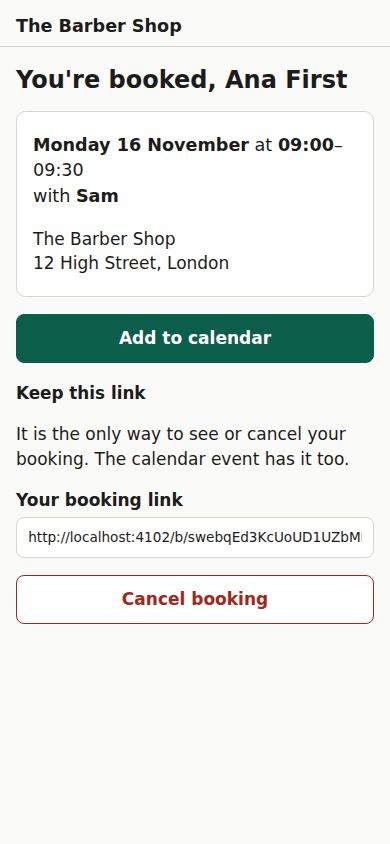 |  |
2. A habit of checking
Every loop opened by re-running the previous loop's checks, and closed by adding its own. The checks grew with the product.
| First request | Second request | Third request | |
|---|---|---|---|
| Asked for | Booking page, no account | Time off and a cancel link | A second barber, or "no preference" |
| Started by re-running | — | the first loop's checks: 37/37, 3/3 | the second loop's checks: 56/56, 5/5 |
| Unit tests at the end | 37 | 56 | 88 |
| Real-browser tests at the end | 3 | 5 | 7 |
The browser tests matter. loop0 asks for real use before a loop is reported — the application tried the way its user will use it, which for a web app means its forms in a real browser — and to say so when it cannot. In the first loop, that browser check hit a trap: the app sent a privacy header, Referrer-Policy: no-referrer, under which a browser sends Origin: null with a form, and the app's own cross-site protection refused it. Every booking would have failed. The agent fixed it, and left a comment in the code: no-referrer sends "null".
No unit test can see this. Only a browser does.
3. A memory in the repository
Between two sessions, an agent forgets everything. On the loop0 side, each new loop started from files, not from a chat:
- PRODUCT.md — who it is for and the client's journey
- ARCHITECTURE.md — five diagrams, each explained, that match the code
- INFRASTRUCTURE.md and DECISIONS.md — how to run it, and why each choice was made
- A mission and a report per loop, the report checked by loop0
- A devlog page per loop, with the screenshots the agent took in the browser
And what a loop did not finish was written down and carried into the next mission: 6 items into the second loop, 8 into the third. Nothing slipped away between sessions.
The devlog can be read on this site: a page per loop, with its screenshots. We kept the other documents, the missions and the reports.
4. A clear place for the human
In this experiment nobody was there to answer: the agent was told to pick sensible defaults and say which. On the loop0 side, every such default was written down as assumed — 28 of the 31 decisions — so the owner can review them later instead of discovering them in production.
The best example is the one our grid counted as a failure. With two barbers, the agent let a barber open a colleague's day. Our grid said "each barber sees only their own day", so it fails. But it was not a silent bug: it is decision D30, with its reason (in a two-chair shop, barbers cover for each other), the alternatives (only their own day, or an owner role) and the status assumed, waiting for the owner. One line to read, one answer to give.
That is the human's place in a loop: approve the mission, decide what was assumed, accept the loop.
The same agent, on its own
| Without loop0 | With loop0 |
|---|---|
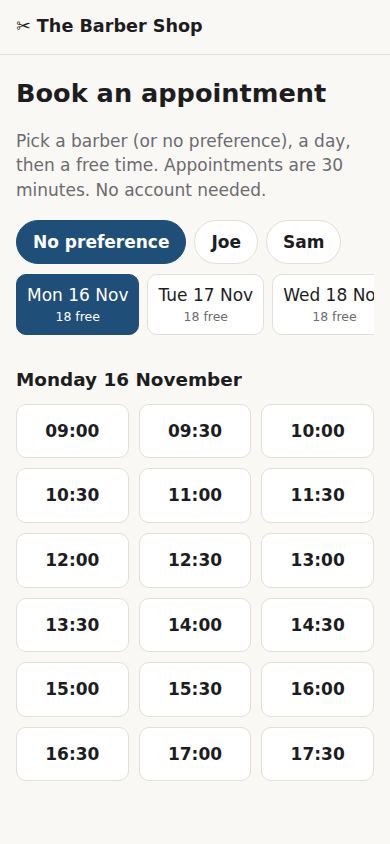 | 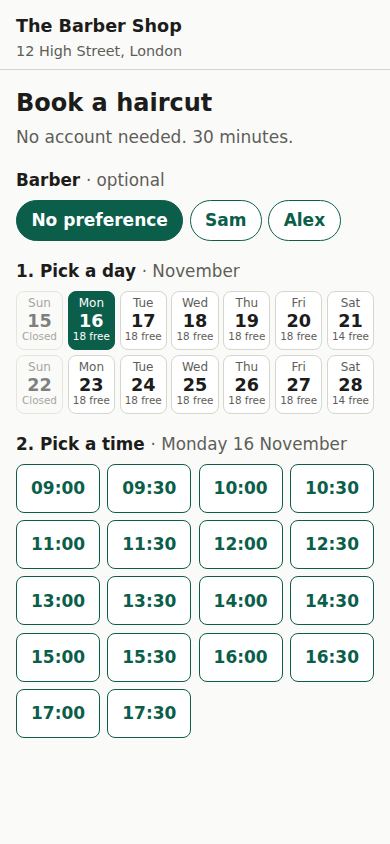 |
The agent on its own did good work. Barber choice with "no preference", a day picker, large time buttons, pages that work without JavaScript, 41 green tests. Its logic was right.
It also chose the same privacy header and the same cross-site protection. Nothing asked it to try its forms in a browser, so it did not, and its reports did not say so. In a real browser, every booking was refused — and so were the time-off form and the cancel button.
| Without loop0: after "Confirm booking" | With loop0: after "Confirm booking" |
|---|---|
 | |
This is not a story about a careless agent. The loop0 side hit the very same trap. The difference is that one side had a step that made it look, and the other did not. In an earlier trial, before loop0 asked for the browser check, both sides shipped this exact bug. One header to change, and most of the problem disappears. But someone has to see it first.
On documents, the agent on its own kept a good README. There was no architecture, no decisions, no trace of each loop.
What it cost
| On its own | With loop0 | |
|---|---|---|
| Time | 25 min | 74 min |
| Turns | 134 | 461 |
| Cost | $5.40 | $21.02 |
Structure costs more and takes longer: writing the mission, testing in a browser, keeping the documents true. We are not trying to make agents cheaper. We are trying to make what they deliver work, last, and make sense to the next person — or the next session — that opens the repository. Some of that cost was plain waste on loop0's side, and it has been removed.
The limits
One product, one agent and model, one run per side, and we built loop0. The functional gap comes from a single bug, which is the point, and also why it needs more runs. Next: other products, and Codex on both sides.